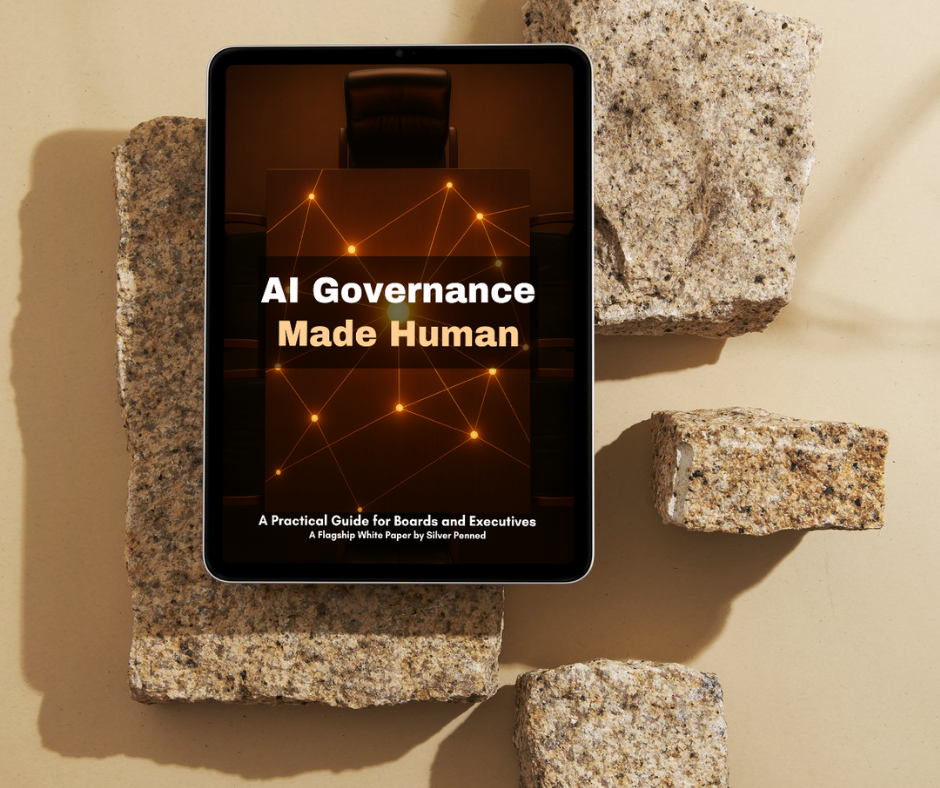
AI Governance Made Human
A Boardroom Guide to Responsible Innovation
Translate complexity into clarity. Turn AI oversight into trust.
Artificial Intelligence has become a boardroom reality — influencing how organizations make decisions, manage risk, and communicate with stakeholders.
Yet most governance frameworks weren’t built for it.
AI Governance Made Human bridges that gap.
Developed by Kate Ginnivan, Corporate AI Integration Strategist & Board Adviser, this flagship whitepaper helps directors and executives:
✅ See where AI already touches your organization
✅ Understand the risks, responsibilities, and opportunities
✅ Build confidence without technical overwhelm
✅ Align innovation with purpose, ethics, and people
This is not another hype report.
It’s a practical governance guide — clear, evidence-based, and designed for leaders who want to act with integrity and foresight.
Download your complimentary copy and discover how to move from compliance to confidence in 90 days.
Trusted by boards and executives leading responsible innovation across Australia and beyond.
The 5 Steps to AI Literacy
(How Boards and Business Leaders Build Confidence, Not Just Competence)
Step 1 — Awareness: Know What AI Is Doing in Your Business
AI literacy begins with visibility.
Every board and leadership team should be able to answer three basic questions:
What AI systems or models are we currently using (internally or via vendors)?
What decisions do they influence — financial, operational, or human?
Who owns the oversight?
Without this awareness, AI remains a “black box” that makes invisible decisions with visible consequences.
Clarity is the first shield against risk.
Step 2 — Principles: Anchor AI to Organisational Values
AI doesn’t operate in a moral vacuum — people do.
A literate board ties every deployment to clear ethical anchors: fairness, accountability, transparency, privacy, and human oversight.
Ask:
Do our systems align with these principles in practice, not just policy?
Can we explain to clients, regulators, or staff how AI supports — not undermines — our values?
Ethics turns curiosity into credibility.
Step 3 — Interpretation: Read and Question AI Risk Reports
AI literacy isn’t about coding — it’s about comprehension.
Boards don’t need to build models; they need to interpret the insights that govern them.
That means knowing how to read:
Model performance metrics and bias reports
External assurance reviews
Data protection impact statements
An informed question from the board can prevent a thousand hours of downstream confusion.
Interpretation builds authority.
Step 4 — Engagement: Learn Through Simulation and Scenario
Theory doesn’t build confidence — experience does.
Boards that engage in practical exercises—AI incident simulations, ethics workshops, or case-based discussions—gain fluency fast.
In one afternoon, directors can experience how bias, automation, or misaligned incentives play out in real decisions.
These simulations create situational awareness: the ability to ask better questions under pressure.
Curiosity, when structured, becomes capability.
Step 5 — Integration: Embed AI Literacy into Governance Rhythm
AI understanding must become a standing item, not a special project.
The most effective boards integrate it into:
Annual strategy and risk reviews
Leadership performance metrics
Procurement and compliance sign-offs
AI literacy matures when it’s not an initiative — it’s an instinct.
Integration turns knowledge into habit, and habit into oversight maturity.
A Boardroom Guide to Responsible Innovation
Artificial intelligence has become a boardroom reality — influencing how organisations make decisions, manage risk, and communicate with stakeholders. Yet most governance frameworks weren’t built for it.
AI Governance Made Human bridges that gap.