From Literacy to Leadership
The Three Stages of AI Fluency That Separate Experimenters from Experts
Most professionals are using AI like Google in 2004 — they’re searching, not strategising.
They open prompts, test ideas, and copy templates, hoping to catch insight through trial and error. The results are interesting, even helpful — but rarely transformative. Curiosity has replaced clarity.
The truth is, the gap between those who play with AI and those who profit from it has nothing to do with the tool. It has everything to do with the thinking. Fluency has quietly become the new professional currency — the skill that separates automation from authority.
Across sectors — from wellness to consulting to corporate leadership — most teams are still anchored at a basic literacy level. They’re using AI to write, but not to redefine their professional edge. The next competitive advantage won’t belong to those who can use ChatGPT; it will belong to those who can lead with AI clarity — turning automation into advantage, and experimentation into execution.
This isn’t a software revolution.
It’s a leadership evolution — one where structured intelligence becomes the hallmark of credibility.
The Three Stages of AI Fluency
AI adoption isn’t a tool rollout. It’s a mindset upgrade.
Every professional — from therapist to consultant to executive — climbs the same ladder of literacy. What changes at each stage isn’t the technology; it’s the thinking framework behind it.
Each rung reshapes how professionals interact with information, make decisions, and communicate trust. It’s less about prompts, more about posture — moving from curiosity to clarity, from efficiency to authority.
This is Silver Penned’s AI Literacy Ladder, built on the AI Literacy Learning Progression Framework now used in boardrooms, clinics, and leadership programs worldwide. It distils complexity into three disciplined phases that evolve how professionals work, think, and lead.
Clarity. Speed. Trust.
That’s the progression — and the promise.
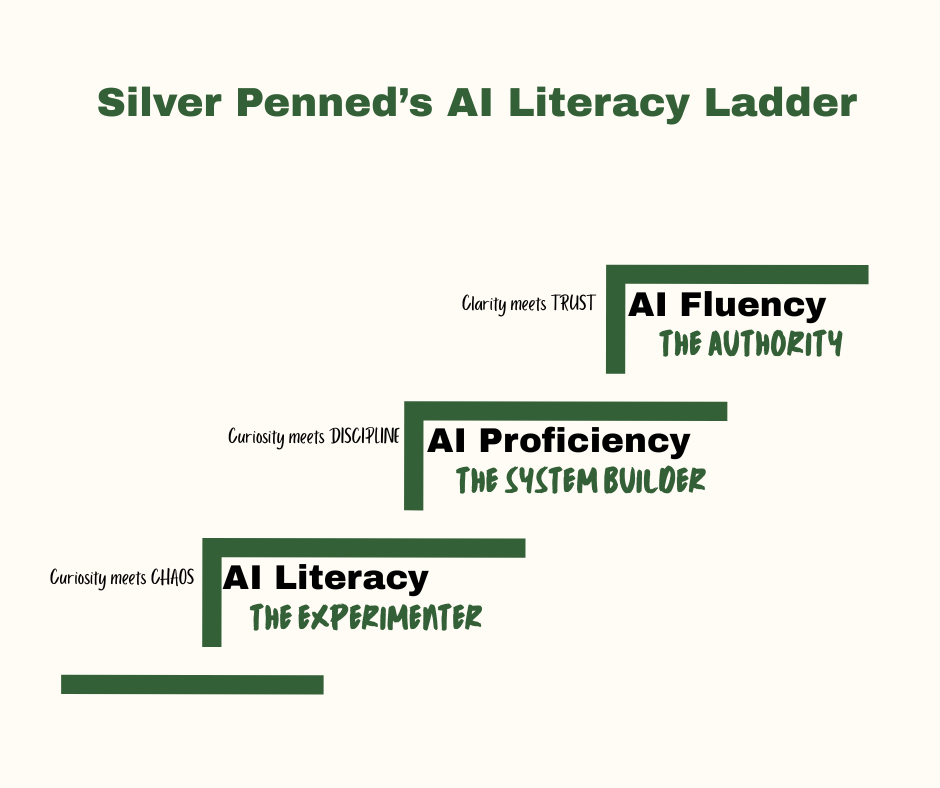
Stage 1: Literacy — The Experimenter
AI literacy begins where curiosity meets chaos.
Most professionals start here — using AI to write, summarise, or brainstorm, mistaking activity for advancement. They copy prompts, test templates, and feel a spark of excitement that quickly turns into confusion. The tool is powerful, but the use is shallow. It saves minutes, not meaning.
Without structure, curiosity becomes noise. There’s no policy, no workflow, no safeguard — just digital improvisation. Leaders feel momentum, but under the surface, risk builds quietly: compliance gaps, data exposure, inconsistency in tone and ethics. This is how “AI-ready” becomes a false comfort.
Progress begins the moment curiosity gets direction. When teams stop chasing novelty and start mapping where AI fits safely, experimentation turns into execution. At Silver Penned, we call this the Clarity phase — the discipline of separating hype from high-trust use.
One clinic learned this the hard way. Its practitioners were drafting client notes with AI, unaware that unfiltered data was leaving the network. Governance was introduced — and everything changed. Notes stayed secure, sessions ran smoother, and staff gained time without losing integrity.
From hesitant curiosity → to informed clarity — this is the first real step toward fluency.
Stage 2: Proficiency — The System Builder
The move from literacy to proficiency happens quietly — a shift from dabbling to designing.
Professionals at this stage no longer ask, “What can AI do for me?” They ask, “How can I make this repeatable?” Templates emerge, prompts become workflows, and creativity turns into consistency.
This is where curiosity meets discipline.
Teams start tracking hours saved, not just words written. They talk about compliance and quality, not just speed. AI begins to scale intelligence, not just output — because systems remove the guesswork that once made adoption exhausting.
At Silver Penned, we call this the Speed phase — where structure becomes the shortcut. It’s the moment professionals realise that success with AI isn’t about knowing more prompts; it’s about operationalizing intelligence.
One consulting firm captured this perfectly. They replaced unstructured brainstorming with a unified AI workflow for proposal writing. Suddenly, three-hour drafts became thirty-minute masterpieces — consistent, compliant, and client-ready. Efficiency became elegance.
From scattered experiments → to disciplined systems — this is where confidence begins to take shape.
Stage 3: Fluency — The Authority
Fluency is the summit — where AI stops being a helper and starts becoming an ally.
At this level, professionals lead with AI, not loiter behind it. They integrate it into decisions, governance, and communication. They don’t ask if AI fits their brand — they ask how AI can amplify their judgment and uphold their ethics.
This is where clarity and speed converge into trust.
Fluent professionals treat AI as a co-strategist — building organization-wide systems that protect compliance, elevate brand tone, and prove ROI in real numbers. They can walk into a board meeting and show, line by line, how AI supports outcomes, not just operations.
This is the Trust phase, where AI fluency becomes visible authority. It tells clients, regulators, and stakeholders: “We don’t just use AI. We use it well.”
One leadership team did exactly that. By embedding AI governance dashboards across departments, they turned uncertainty into oversight. Reports became boardroom assets; audits became effortless. Confidence replaced anxiety.
From structured competence → to trusted authority — this is the moment AI becomes part of your professional identity.
The Ladder in Motion: The Leadership Arc
The journey from Literacy to Fluency isn’t about learning new technology — it’s about unlearning old habits.
AI fluency doesn’t start with prompts; it starts with posture — the confidence to lead with clarity, speed, and trust.
Every rung of this ladder redefines leadership:
Clarity gives you confidence.
Speed gives you scalability.
Trust gives you authority.
This is the rhythm that separates experimenters from experts — and transforms AI from a distraction into your professional differentiator.
The Real Transformation: From Efficiency → to Evolution
The biggest myth about AI is that it’s about saving time.
The truth is simpler — and far more powerful. AI doesn’t just make professionals faster. It makes them formidable.
When AI is applied with structure and governance, something deeper happens: teams stop chasing output and start embodying clarity. Processes become calm, not chaotic. Reports read with authority, not anxiety. Work begins to feel composed again — not just completed.
This is where Silver Penned’s AI Literacy Ladder merges with leadership identity. It isn’t about mastering prompts — it’s about mastering presence. AI becomes the quiet engine behind your professionalism, not a shortcut for your workload.
In therapy practices, that looks like moving from compliance chaos → to clinical confidence.
In consulting, it’s the shift from vendor status → to boardroom authority.
For entrepreneurs, it’s turning content noise → into brands with gravity.
These aren’t technical upgrades — they’re identity shifts.
Fluency becomes the bridge between efficiency and credibility; the point where skill turns into distinction.
From Prompt-Aware → to Identity-Calibrated.
From Experimenter → to Exemplar.
Because Silver Penned’s philosophy is simple:
“We don’t automate tasks. We operationalize evolution.”
From Local Practice → to Global Authority
AI fluency has become the new language of leadership — and geography no longer protects ignorance.
What once felt optional is now organizational DNA. From boardrooms in Sydney to strategy tables in Singapore, from London regulators to Los Angeles startups — the question has shifted from “Should we use AI?” to “Can we prove we’re using it responsibly?”
Organizations that lead early aren’t just modern — they’re setting the standards others will follow. In Australia, therapeutic networks are already aligning with NDIS-aligned AI compliance frameworks. Across the UK, consulting firms are embedding AI governance matrices into annual reports. In the US, entrepreneurs are building custom bots trained on their brand voice and ethics policies, creating transparency their competitors can’t yet match.
Fluency now signals authority. Your AI maturity has become your credibility index — a visible measure of how trustworthy, efficient, and forward-thinking your brand truly is.
From local compliance → to global leadership — the future belongs to those who can govern innovation before it governs them.
Literacy Isn’t Enough Anymore
AI literacy will keep you relevant.
But AI fluency will make you respected — and ultimately, irreplaceable.
The leaders shaping the next decade aren’t the ones asking if their teams should use AI; they’re the ones asking how to lead with it — safely, strategically, and credibly. They’ve moved beyond dabbling with prompts and into building cultures of structured intelligence, where every AI use case aligns with compliance, communication, and credibility.
That’s where Silver Penned begins — with AI Audits, Governance Readiness Programs, and AI Literacy Accelerator Workshops that map exactly where you stand on the ladder: Literacy, Proficiency, or Fluency. Each engagement builds a 90-day roadmap that turns experimentation into execution — and execution into excellence.
Because the future won’t reward speed alone.
It will reward situational awareness — the ability to read the landscape, not just react to it.
From curious adopter → to credible authority — this is the new measure of modern leadership.
Ready to see where your organization stands on the AI Literacy Ladder?

Download the AI Governance Readiness Checklist — your boardroom-ready diagnostic to assess AI maturity across clarity, speed, and trust.
In five minutes, you’ll know exactly which stage you’re in — and what it takes to move from experimentation → to execution → to excellence.